|
 |
|
|

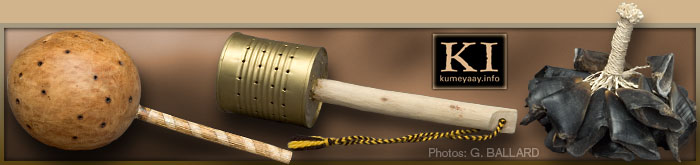
NATIVE AMERICAN INDIAN TRADITIONAL GOURD RATTLESThe Kumeyaay word for gourd rattle is: HalMa Halma is the primary traditional musical instrument of the Yuman tribal peoples. It is played by shaking in rhythms and usually accompanies a singer, storyteller, or medicine person. Hand rattles are very old timeless musical instruments that date back to the archaeological Late Prehistoric Period. Five basic styles today include rattles made from gourds, ceramic clay, deer toes hoofs, turtle shells and tin cans (post European contact). Top picture caption above: Gourd rattle construction by: (L-R) Famous indigenous ethnographic artist Nick Wilson COCOPAH, an expert authority on how to make genuine Indigenous California-style rattles, Frank Escalante QUECHAN, Alonso Pesado COCOPAH, Nick Wilson CUCAPA, Nick Wilson COCOPAH, Daleane Adams KUMEYAAY (baby rattle), Sarah Kingery, Nick Wilson CUCAPA, Eric Nicolas Kingery KUMEYAAY. Beautiful color contemporary photos, audio recordings and digital video of tribal rattles being played by American Indians in the U.S.-Mexico border region in greater Tijuana and San Diego: Color historical and contemporary high-resolution digital photography and video of American Indians in traditional clothing playing gourd rattles, singing and dancing at the turn of the 21st century in County of San Diego and northwestern Mexico.
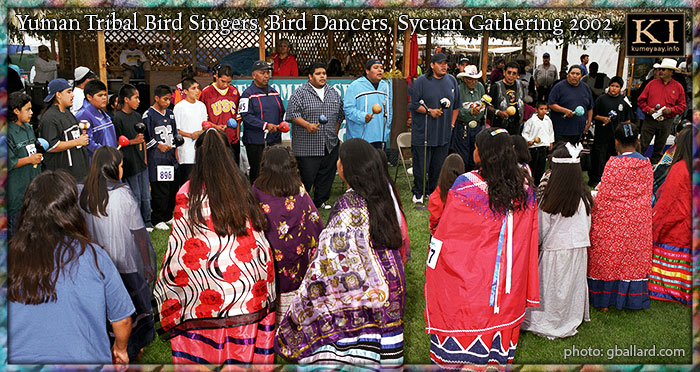
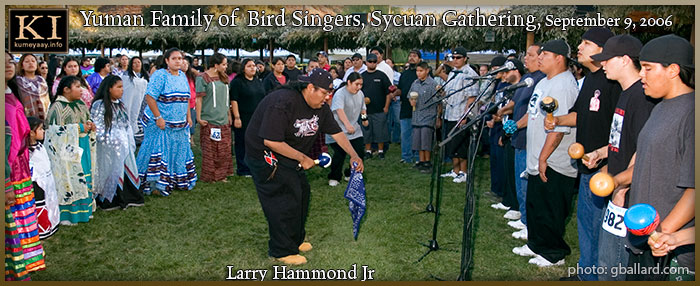
Traditional gourd rattles used by the aboriginal Kumeyaay California Indians of North America, the indigenous peoples of Southern California, southwestern Arizona, San Diego County, northern Baja California, Mexico, are typically played during traditional Native American singing dancing, the bird songs bird dances of the Yuman Indians, including religious, spiritual and medicine ceremonies, including entertainment.
DIRECT PLAY JON MESA MOVIE .MP4
Kumeyaay Caption Information (above picture): Lead Singer: MR. LARRY HAMMOND JR., Singers: LIONEL HAMMOND, NATHAN DICK, LEVI EVANSTON, ISIAH EVANSTON,TIM AKA BIM STEVENS, MARY WALEMA, EDDIE LEAL, JOHNNY HEMMERS, TYRONE THOMAS, HUBERT MCCORD, SAM EVANSTON, SHAN LEWIS JR., GABRIEL LEIVAS, KIETH JENKINS, JESSE OCHOA, ELIAS AMEELYENAH, EDWARD DOCK, EMILIANO CASTILLO, DANIEL CASTILLO, UNCLE JOE SCERATO, and Samuel Q. Brown (Viejas). Caption Source: AHA MACAV AVI KWA AME BIRD SINGERS MySpace.
Mr. LEROY ELLIOTT chairman of the Manzanita Band of the Kumeyaay Nation pictured in 2006 singing and shaking a painted blue Yuman rattle with eagle feather artwork.
Chairman Elliott (tan hat) leads a group of Kumeyaay bird singers in honor of Jane Dumas Day April 28, 2012. Nearly every local tribal event features these types of cultural performances. CULTURAL RENAISSANCE 2000:
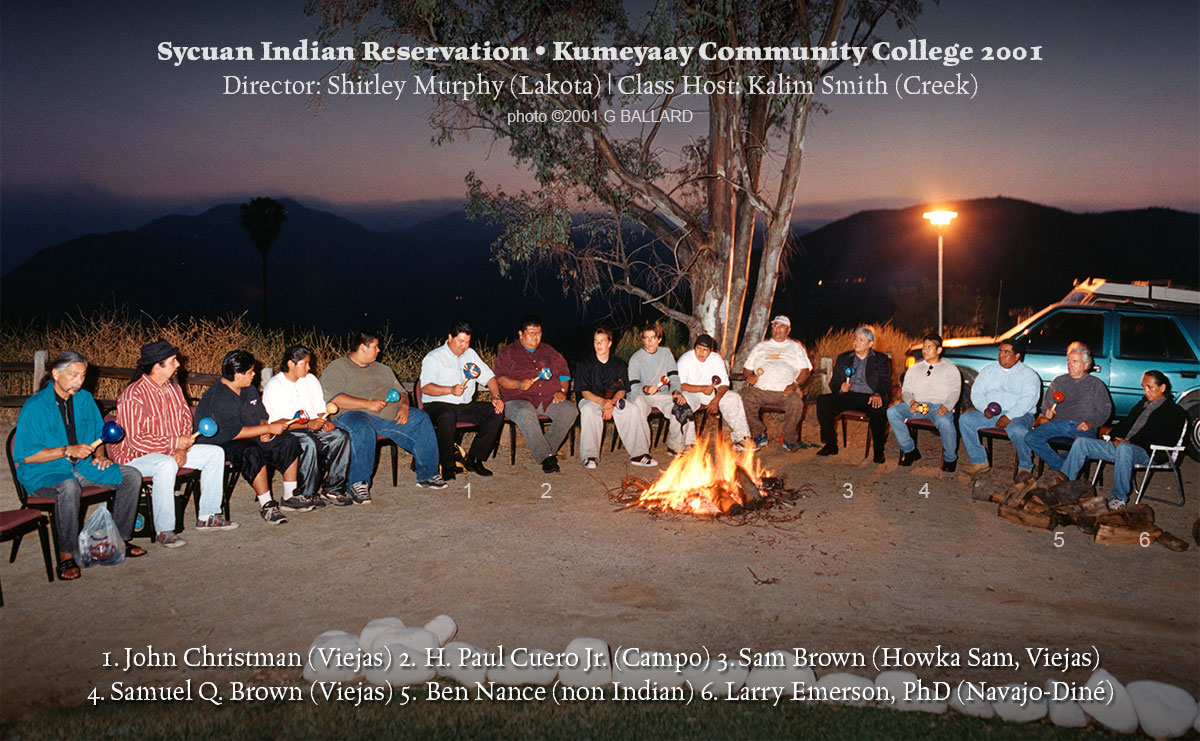
Turn of the 21st century Yuman language singers (above), Sycuan Indian Reservation, Kumeyaay Community College (formerly DQ University at Sycuan), are pictured here in this photograph around a burning campfire learning and singing some of the timeless traditional "bird songs" of their Indigenous ancestors.
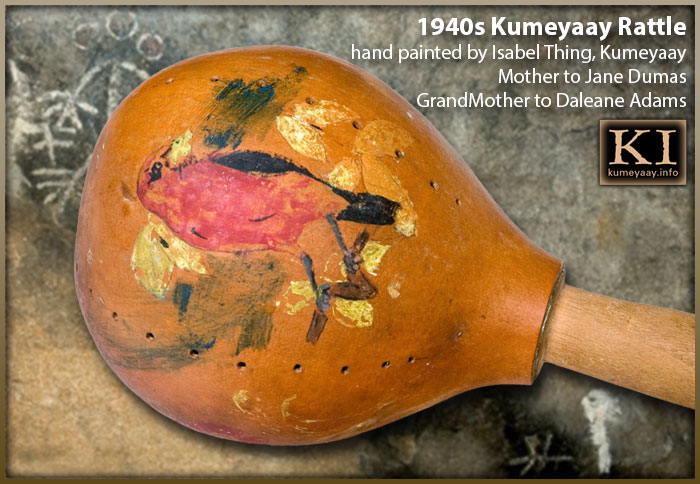
ANTIQUE KUMEYAAY RATTLE two painted red birds with white wings hand painted on a gourd rattle in the 1940s by Isabel Thing, Kumeyaay, mother to Jane Dumas (Jamul) and grandmother to Daleane Adams-Thing (Jamul). Jane and her Kumeyaay mother, Isabel, were both medicine people. Access to take studio photos of family cultural heirlooms granted by kumeyaay.info contributor Jane Dumas. MORE INFO
MOVIES & AUDIO RECORDINGS:
DIRECT PLAY POWWOW MOVIE .MP4
DIRECT PLAY TECUMSEH MOVIE .MP4
DIRECT PLAY SCREENTEST .MP4
DIRECT PLAY EWAA MOVIE .MP4 NATIVE RATTLES Making Constructing: Native American rattles, aboriginal musical instruments, are typically constructed of natural gourds, condensed milk cans and evaporated milk cans, desert willow handles, palm seeds to make rattle sounds, agave cord, willow and mole fat handles. Authentic deer-hoof rattles are handmade with twisted agave fiber cord handles and real California deerhoofs, sometimes called deer-toe rattles. Deer-hoof musical and ceremonial rattles are generally played only during Native American funerals and wakes and their dried animal hoofs make a very distinctive sound when shaken. Another type of California Indian rattle is a turtle-shell rattle; it's constructed by sticking a wooden handle through a tortoiseshell, inserting palm seeds and sealing off the openings. The oldest known museum relics of ancient North American rattles are indigenous clay rattles, likely because the clay survived the ages whereas the other organic natural materials deteriorated over time and were lost. SAMUEL BROWN kumeyaay.org outlines instructions with tutorial photos about how to make a Kumeyaay Indian gourd rattle -- in Kumeyaay language -- Sam, a Native speaker, calls the Kumeyaay rattle "HalMa". KUMIAI SINGERS IN MEXICO
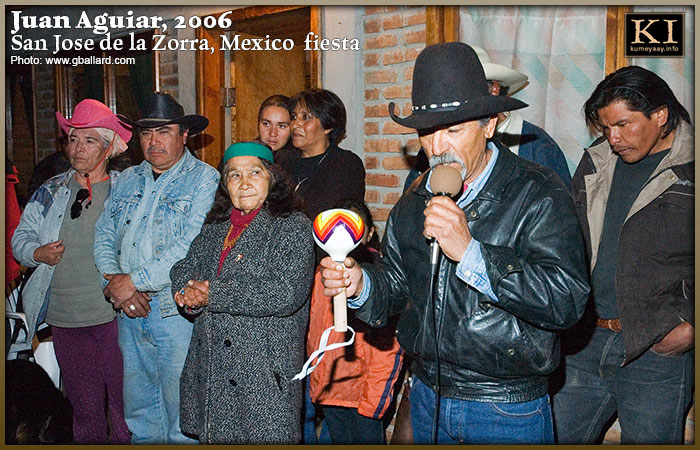
Tribal singer Juan Aguiar (San Antonio Necua) performs at a cultural fiesta in San Jose de la Zorra, Baja California Norte, Mexico. MORE audio
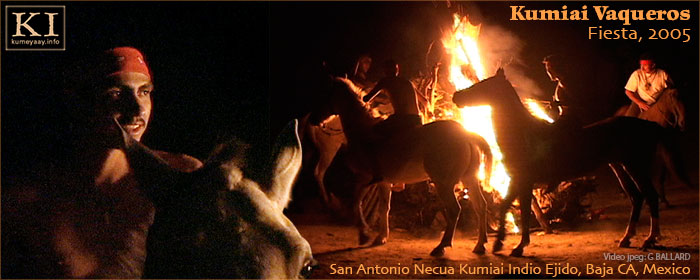
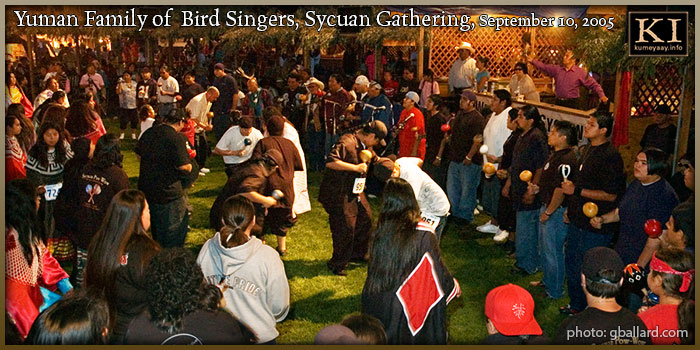
TWO FAMOUS CALIFORNIA INDIAN SINGERS pictured singing live into a microphone and shaking traditional Indian rattles at the SAN ANTONIO NECUA KUMEYAAY FIESTA (2005) in San Antonio Necua, Mexico, and lower, a large group of California tribal bird singers and bird dancers at Kumeyaay gathering on a San Diego County Kumeyaay reservation (2005) playing gourd rattles, singing and dancing.
THREE TURN OF THE 21ST CENTURY RATTLES
This fancy modern gourd rattle was gifted to me (the webmaster) by Ernie Salgado (Luiseño). It's a 2010 spin on traditional North American Indigenous-style rattle, painted black with custom beadwork design covering the handle, white leather strap with silver jewelry. The fancy rattle was handmade by Karen Nelson (Sioux tribe); she is married to Willie Nelson and they live on the La Jolla (Luiseño) reservation in San Diego County.
By comparing the fancy black beaded 2010 rattle with this natural 2006 Yaqui rattle -- there can be a huge difference in today's modern turn-of-the-century gourd rattles depending on the tribe, artist, and area of origin. The fancy beaded rattle was made in the Southwest USA for a prospering crop of American California Indian singers -- the natural Yaqui rattle was likely made for local Indigenous tribal singers down in Mexico. The webmaster recalls he paid around $40 USD for the Yaqui rattle (with a good tip) and the beaded rattles were retailing for around $150 USD in the USA. I bought this particular Yaqui natural rattle pretty far down into Mexico in a poor (by American standards) Yaqui Indian village directly from the artist while visiting his home on the way to Mazatlan, Sinaloa, Mexico. A couple California singers told me they choose their gourd rattles as much for the way they sound when shaken as the way they look. The Yaqui rattle has a loud crisp sound, the black beaded rattle makes a much deeper, less crisp sound when rattled. DEER HOOF RATTLE aka Deer Toe Rattle
PECHANGA BAND OF LUISENO INDIANS (used to) keep an interesting article on their official tribal website -- check out their in-depth cultural article about rattles if you have an interest in learning about authentic California Indian rattles from a tribe's perspective:
The above pictured authentic museum quality North American deer hoof rattle was handmade in the San Diego border region likely in 2004 -- I borrowed it from the now closed Shumup Ko Hup Indian store in Old Town San Diego State Historic Park to photograph it for this online tribal museum -- the Shumup Ko Hup store specialized in authentic ethnographic style art made by their co-op of California Indian artists. Look closely -- the Indian string was locally harvested from San Diego area agave plants, its fibers extracted from the plant's leaves, and then dried and twisted by hand into agave cords. Then the agave cordage was threaded through the California deer hoofs and tied off into a finished deerhoof rattle. The "corded handle" is held between the thumb and index finger and shaken to produce the sound. The deer toes make a very distinct sound when shaken in the hand. The only difference between this rattle and one made hundreds or possibly thousands of years ago is this one looks new, the old ones would look prehistoric in our modern time.
What are the deer hoof rattles used for? Deer-hoof rattles today are pretty rare for non-Indians to witness being played -- mostly these ancient style rattles are used today in Southern California during traditional American Indian funerals and wakes. INDIAN RATTLES History in Southern CA: ALSO, please see americanindiansource.com feature, including audio recordings of Kumeyaay bird singer Ron Christman performing live, and the Ipai-Tipai published article by Ron Christman Traditional Origins of Southern California Bird Songs. Movies, Audio, Video, Clips, Professional Pictures:
|
|||
| LISTEN TO MUSIC CDs BEFORE YOU BUY
SHUMUP KO HUP Native American music store formerly in Old Town San Diego, California, offered California Indian GOURD RATTLES and music CDs for sale -- you can even listen to some audio CDs of gourd singers on their web site. |
|||
| Terms of Use • Privacy Statement • Site Map Kumeyaay Indians Home • About Us • Mission Statement • Press Kit • Contact Us |



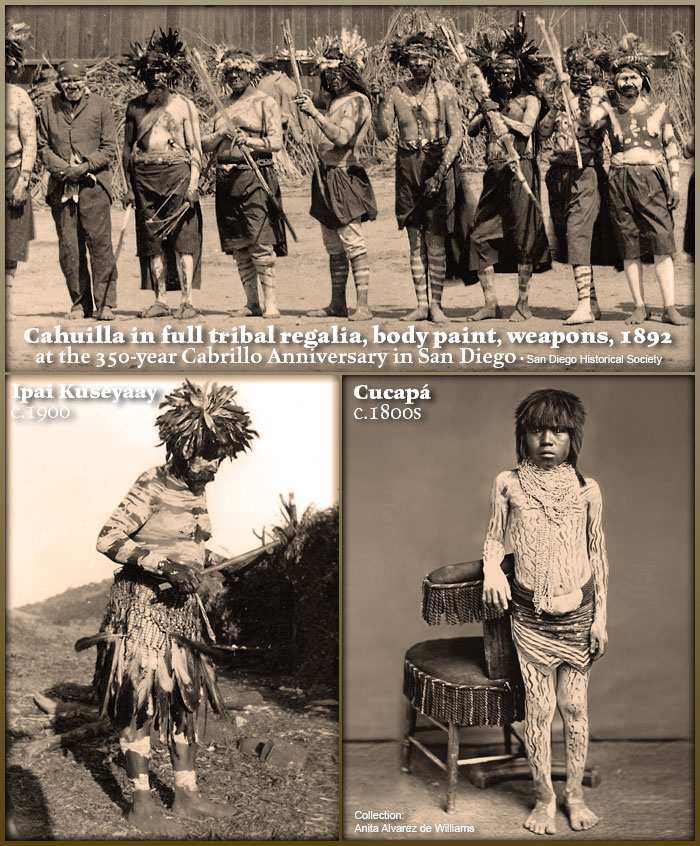
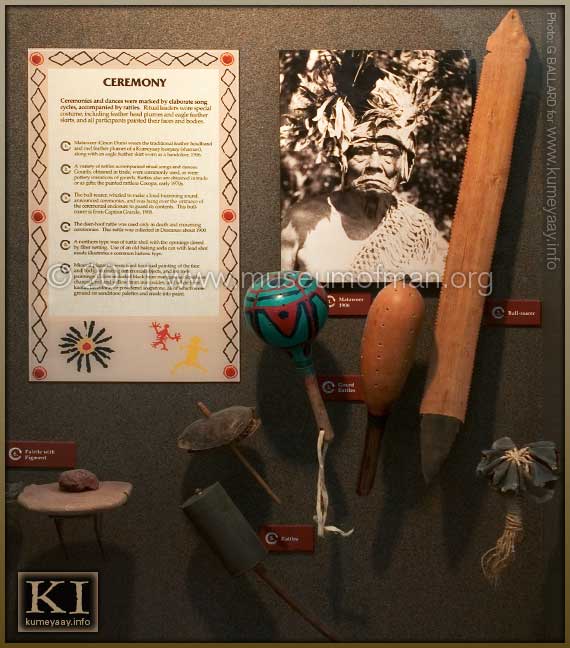 An extensive Museum of US cultural display on the Kumeyaay features Cinon Mataweer and exhibits classic types of Southern California Indian spiritual objects he would have used in his ceremonies as a Kumeyaay kuseyaay in the late 19th century, including gourd, deer toe, turtle shell and can rattles pictured.
 We don't even know the meaning of some of our bird songs anymore because they are in an old, old language. But we know it's all a story that has been passed down from generation to generation.