|
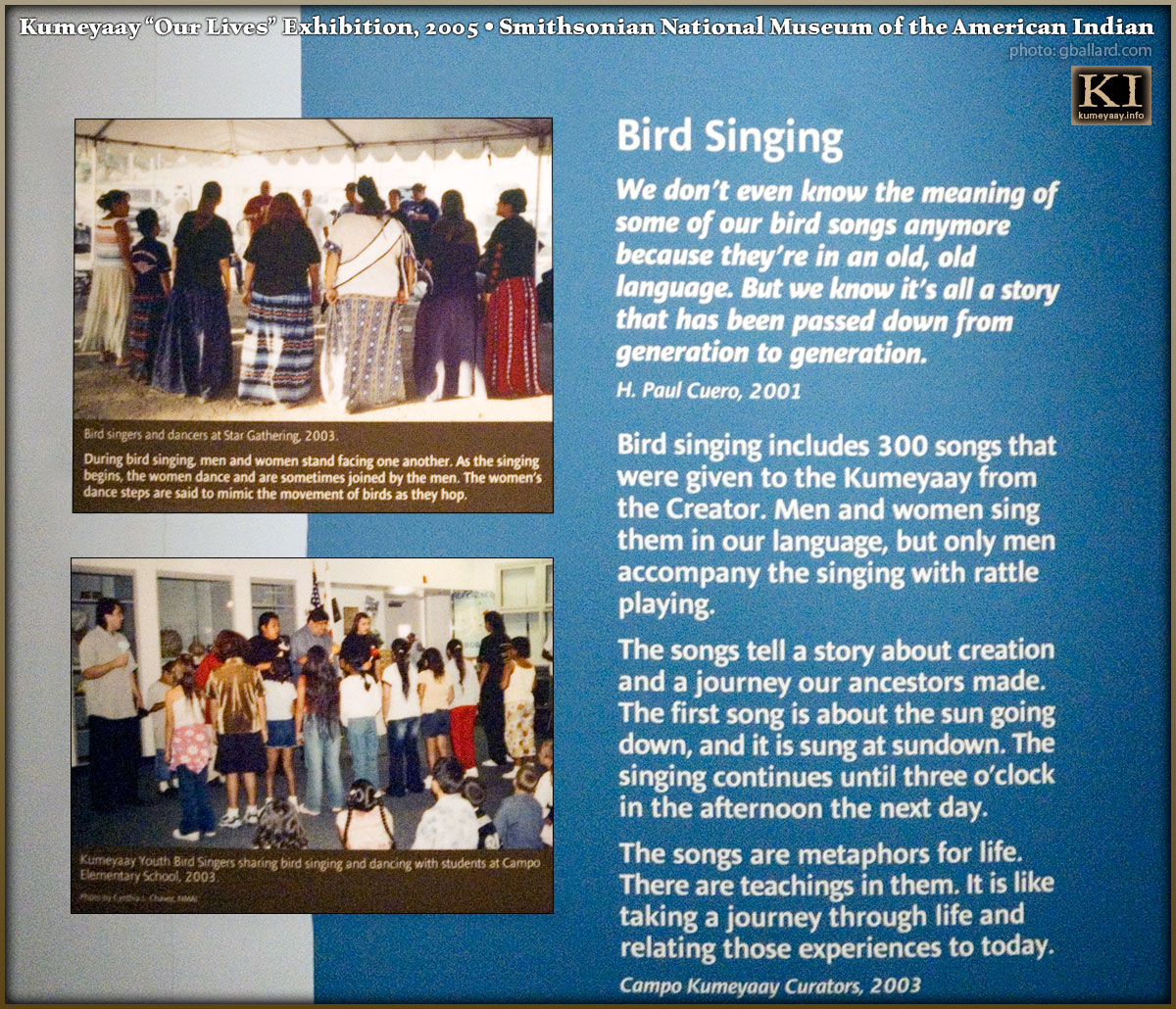
The Smithsonian National Museum of the American Indian "Our Lives" exhibition featured multi-media video recordings of Kumeyaay People talking about their Native American culture from the Kumeyaay perspective.
From the Smithsonian placard:
My roots are here.
I'm Kumeyaay and I'm from Campo.
This is my Ground.
- William Moffett, 2003
The Smithsonian expanded its deep dive into Kumeyaay people with H. Paul Cuero's interview about sharing his tribe's historic association with the Kumeyaay Aboriginal storytelling and song history for museum visitors:

Official Kumeyaay Indian government web site: www.campo-nsn.gov
PHOTO SHOOT and digital production contributed by Hank and Shirley Murphy.

The Kumeyaay Cultural Renaissance, Turn of the 21st Century:
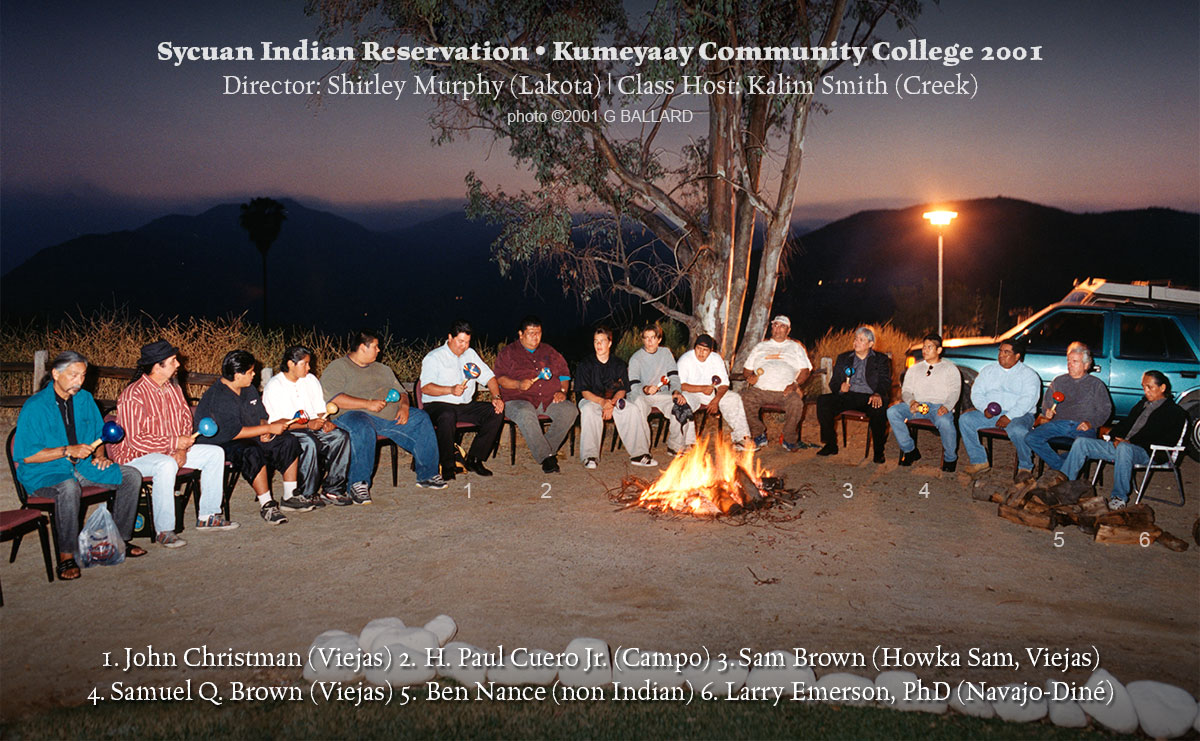
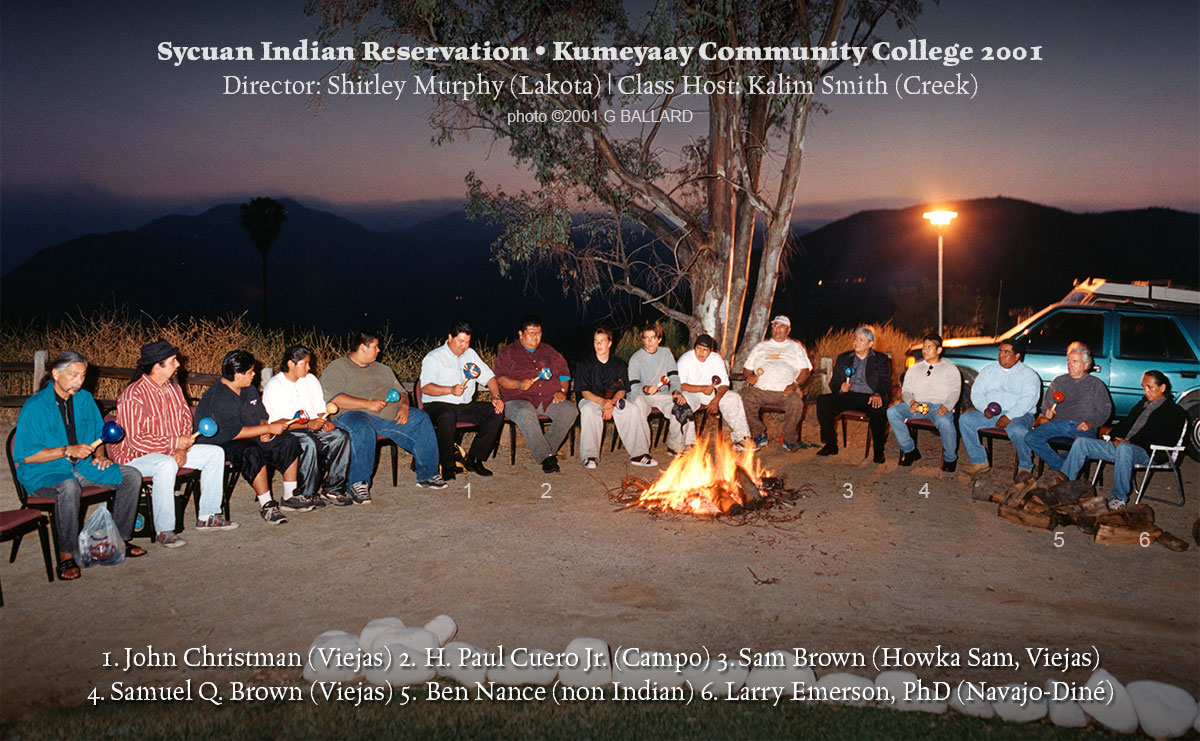
Harry Paul Cuero Jr. (noted #2 in birdsinging photo) was a well-known Kumeyaay tribesman and cultural activist at the turn of the 21st century in the Southern California, San Diego, northern Mexico and East County areas of the United States and US-Mexico border region.
| BIOGRAPHY of Dr. H. Paul Cuero Jr., L.H.D.
1964-2025
Received honorary degree of Doctor of Humane Letters from San Diego State University -- pictured below with Manzanita Chairman Leroy Elliott singing at a Sycuan gathering in 2006.
BIO courtesy of Campo Kumeyaay Mission Indians, 2010:
|
|

Chairman Cuero, fondly called “Junior” by friends and relatives, is a successful cultural and tribal leader. He played a crucial role in drafting, analyzing and refining the California Native American Graves Protection and Repatriation Act (NAGPRA).
He is knowledgeable of cultural program design development and management functions, his work with tribal youth in Southern California helps maintain the traditions of the Kumeyaay and other Tipai American Indian cultures.
A traditional Bird Singer for over thirty years, Chairman Cuero and a group of Kumeyaay youth were invited to perform cultural Birdsongs with the San Diego Symphony Orchestra in a composition which bridged the gap between ancient and new cultures. Chairman Cuero was chosen to open the pre-game ceremony with Bird Songs at the 1998 Super Bowl in San Diego, California, as well as singing Bird Songs at the opening of the Smithsonian National Museum of the American Indian.
Chairman Cuero was chosen to open the pre-game ceremony with Bird Songs at the 1998 Super Bowl in San Diego, California, as well as singing Bird Songs at the opening of the Smithsonian National Museum of the American Indian. Most memorable and probably the only time in history, Chairman Cuero and other Bird Singers were invited by President Clinton to sing at the White House.
Since the age of 19, he has been involved in many aspects of governmental process including serving as Treasurer, Campo Kumeyaay Nation; President, Muht-hei, Inc.; Chairman, Campo Tribal Housing Authority; Chairman, Tribal Enrollment; Chairman, Campo Repatriation Committee and Vice-Spokesman for the Kumeyaay Cultural Repatriation Committee.
His current community commitments include being Chairman of Campo Kumeyaay Nation; Board Member, Muht-hei, Inc., a Tribal Economic Development Corporation; Commissioner, California Native American Repatriation Oversight Commission; Director of Cultural Programs; Traditional Peon Tournament Director and Coordinator of New Kumeyaay Bird Singers and Dancers for Tribal Youth Groups.
Chairman Harry Paul Cuero, Jr. is respected by other tribal leaders, tribal and community members, and most importantly the youth, for his personal traits and values that include patience, confidence and commitment to serving his community.
Photographer's note: The light was very low in this twilight photograph, see the motion in Mr. Junior's rattle... shot on digital Nikon SLR through Nikkor 300mm 2.8 lens wide open, 1/90th second shutterspeed at iso 200 on a Gitzo monopod, Sept. 8, 2026 at 6:43 p.m.
I am pleased with the focus (though slightly front focused), scene mood and pixel quality in this photograph, but these were risky camera settings with no flash (which would have distracted the reverance of the moment). I snapped off a couple frames and got out of the area more quickly than usual.
Paul radiated a deeply spiritual aura -- most people who were blessed with his presence respected that.
|

Hand Rattles of the Kumiai-Kumeyaay-Diegueño-Ipai-Tipaay
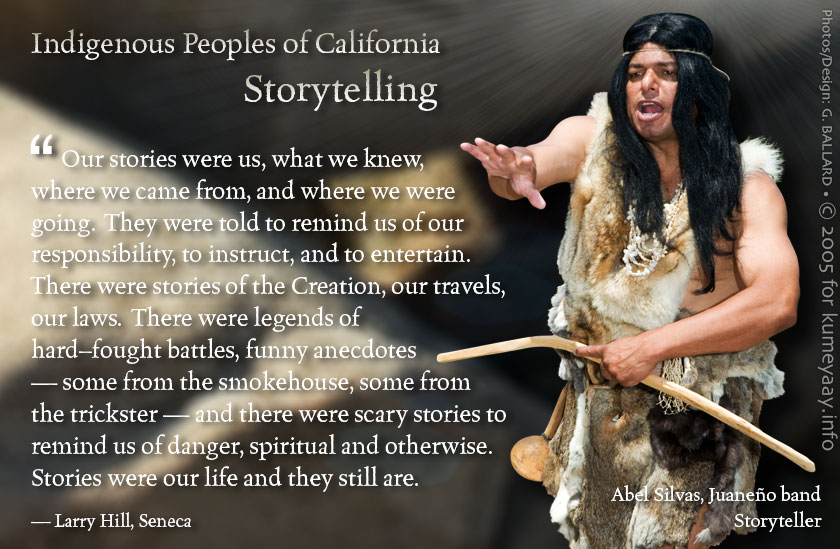
YUMAN Storytellers...
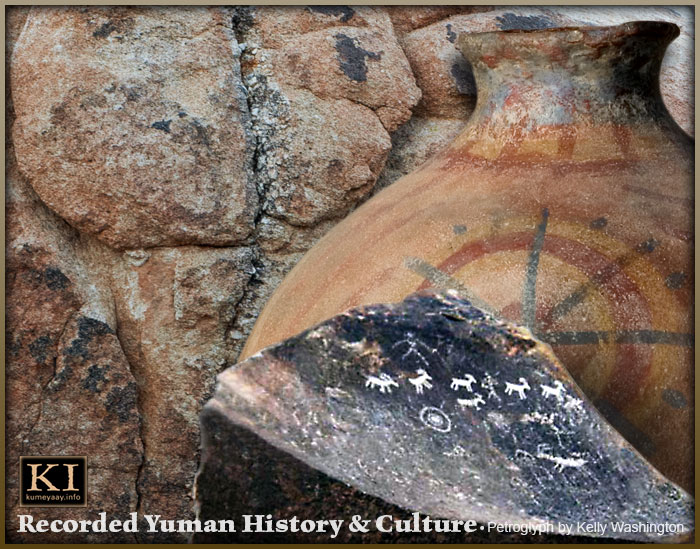
KUMEYAAY CULTURE...
The Yoni granite sculpture background in this composited graphic was photographed at Indian Hill, Anza Borrego Desert State Park in 2004 -- notice the dark aged paint, it must have been all painted up in original celebrated form. The rare Polychrome olla was found in the late 1900s in western Imperial County. The Petroglyph rock was photographed by Kelly Washington in 2004 at Vii Kwame, a sacred mountain for many of the Yuman tribes.
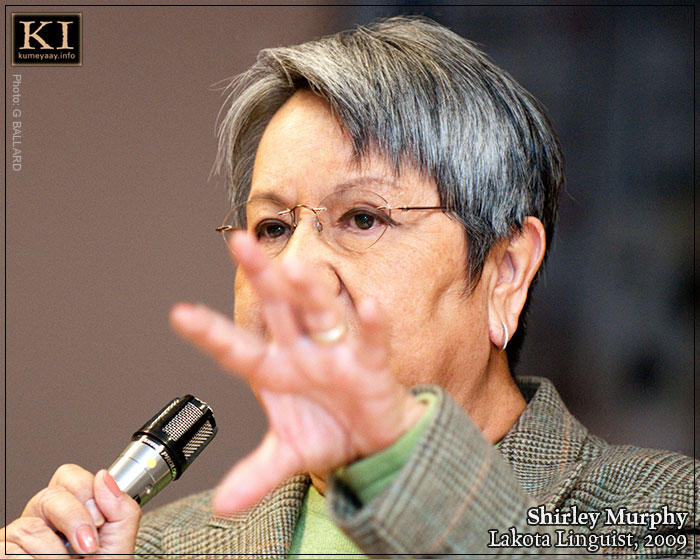
KUMEYAAY LANGUAGE DEPARTMENT...
The Kumeyaay tribe has been categorized within the so-called Hokan Delta-California group of the Yumans.
"Hokan" references an academically-defined group of about a dozen languages spoken mostly by Yuman Native American Indian tribes in Arizona, California, and Baja California, Mexico.
The Hokan group includes Cocopah, Kumeyaay, Maricopa, Quechan, Mohave, Pai Pai, Yavapai, Havasupai, and Hualapai.
The Kumeyaay language spoken by today's Kumeyaay speakers include a northern dialect (Iipay) and a southern dialect (Tiipay).
Kumeyaay website, commentary and design by GARY G BALLARD San Diego.
|