|
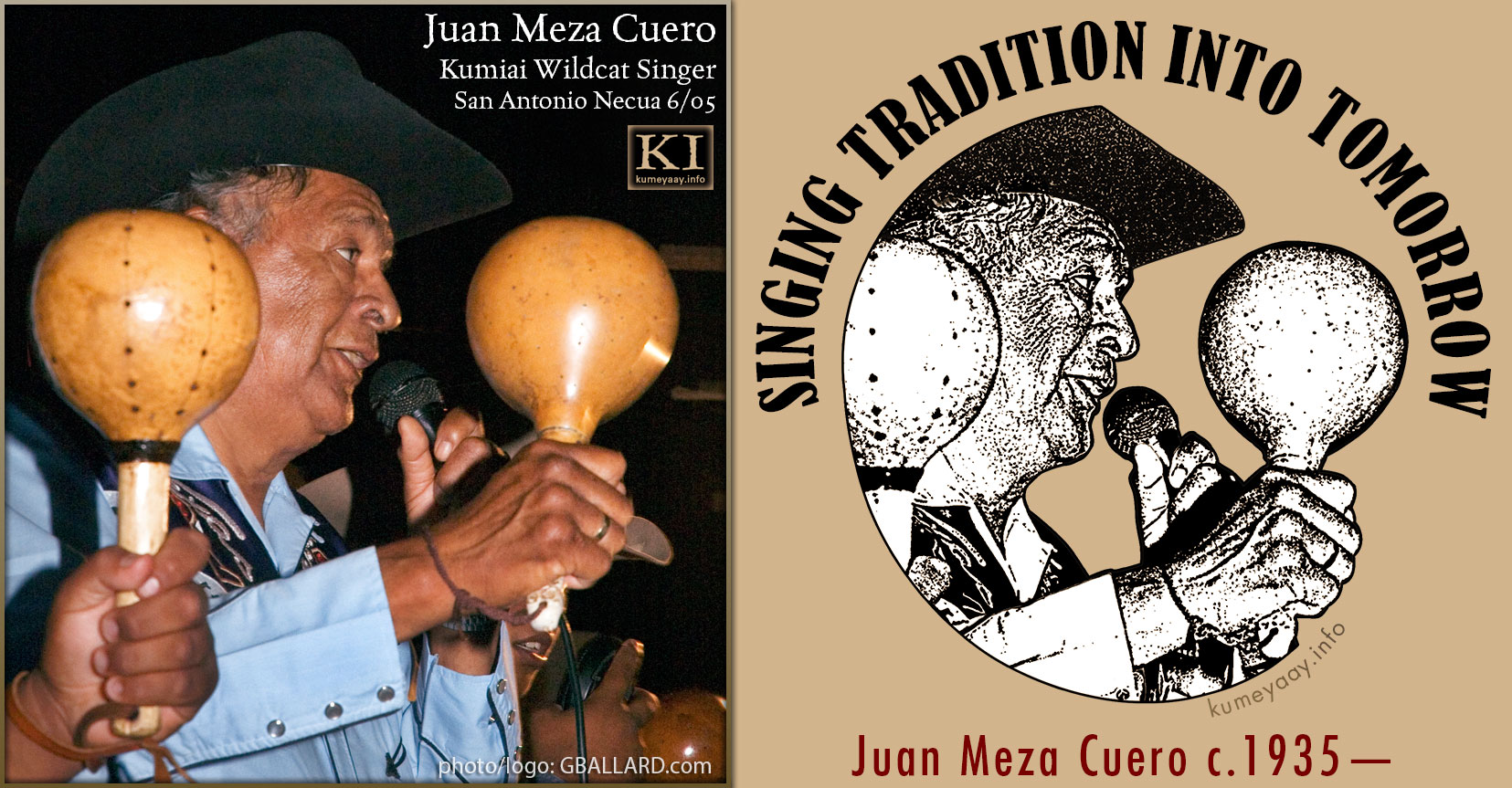
Juan Meza Cuero AKA Jon Mesa, Kumeyaay Kumiai Tipaay Tipai, Echkwechyaaw, a highly-respected tribal Song Leader and teacher of Nyemii Nemi Wildcat, Gato tribal songs, sings generational Yuman bird songs to a southern Diegueño Kumiai Tipai Tipay and northern Iipai Iipay community gathering during the San Antonio Necua indigenista annual Kumiai fiesta, Baja California, northern Mexico, June 13, 2005.
Juan was 70 years in this picture and video.
In this photo, used in Juan's obituary and memorial, the Kumeyaay tribal birdsingers are shaking traditional California Indian gourd rattles to accompany their Native American Indian singing to traditional bird dancers in a rural Kumiai mountain ejido.
STORYTELLER:
Juan Meza is a prolific Native American Indian STORYTELLER through timeless songs and oral histories of the Yuman tribes indigenous to Southwestern United States, Northwestern Mexico, Southwestern Arizona geographical regions -- these areas are his people's ancestral tribal homelands they have occupied for some 12,000 years.
Jon Mesa is one of the best known turn of the 21st century famous Native American Indian Kumeyaay birdsingers wildcat nyemii singers in Southern California, County of San Diego County and Baja California Norte, northern Mexico indigenous communities.
Juan Meza Bird Singer BIOGRAPHY: PDF

Juan Meza Cuero Kumeyaay bird song MOVIE
Juan Meza Cuero INTERVIEW 2001: PDF
(release pending further study, posted July 14, 2026)
I had a challenge finding biographical facts on Juan -- until I stumbled upon this uabc.mx interview. It recorded Juan's birth year "1935" in his own words -- but Jon didn't look that old to me.
His good Native American Indian journalist friend, Roy Cook (Pima), and fellow member of their local San Diego singing group, The Three Aukas -- wrote in Juan's bio (c.2010) that Juan said, "I am now 75 (years old)."
I am still looking for confirmation, if Juan Mesa Cuero is still alive or what year when he may have died for the historical record. Please shoot me an email if you have any information about Juan Meza.
I received an email (Oct. 2026) confirming Señor Juan passed "awhile back." Rest in Peace, my friend.
- AUTONOMOUS UNIVERSITY OF BAJA CALIFORNIA
- INSTITUTE OF HISTORICAL RESEARCH
- ARCHIVE OF THE SPOKEN WORD
- ORAL HISTORY PROJECT
- HISTORY OF TECATE
- INTERVIEW WITH
- JUAN MEZA CUERO
- PHO-8-67
- TECATE, BAJA CALIFORNIA
SOURCE: https://repositorioinstitucional.uabc.mx/
TRANSLATION Español to English by https://chatgpt.com
TRANSCRIBED EXCERPTS
IN HIS OWN WORDS:
 My name is Juan Meza Cuero. I was born on May 26, 1935, in Potrero, California. My parents were Alfonso Meza Cuajo and Rosario Cuero Paipa. My parents brought me to Tecate. My father came to Tecate because of the war that existed back then, because they were killing all the Indians and the U.S. government was persecuting the Native people. They killed everyone who had Native surnames. We came in the 1940s. I was 12 years old. My name is Juan Meza Cuero. I was born on May 26, 1935, in Potrero, California. My parents were Alfonso Meza Cuajo and Rosario Cuero Paipa. My parents brought me to Tecate. My father came to Tecate because of the war that existed back then, because they were killing all the Indians and the U.S. government was persecuting the Native people. They killed everyone who had Native surnames. We came in the 1940s. I was 12 years old.
My father took me to Plateros because my mother died. My father and my grandmother took care of me. My grandmother was Felicitas de Cuero. Back then people did not know who the Kumiai were; they did not know what kind of Native people we were. Here in the north there were Cochimí people and some Paipai who came from Santa Catalina (maybe present-day Santa Catarina). The Kiliwa were farther south of Ensenada.
In the La Huerta area there were Cochimí, Kumiai, and some Paipai. I don't know whether my grandmother was Cochimí or Kumiai. It was the Santa Catalina area....
I experienced traditional Native customs. I remember that when someone died, there were celebrations. A year later they would hold them. When a person died, they prayed and everything, and they held a celebration called "the mourning." The food included beans, meat, potatoes, wheat dishes, and pozole made with wheat or corn. I remember when corn was planted. There were no stores; everything was grown. Since there were no stores, people ate acorns, agave stalks, and gathered honey....
There were no schools. I only learned to speak and write by myself, thank God. I also learned English on my own and to translate Kumiai into English, also by myself. With my relatives I spoke Kumiai and Spanish. I only learned to speak English recently because I never liked Americans, and since I was a teacher of the Indigenous language, I had to translate in three languages: Spanish, Kumiai, and English. In the United States they made me a teacher; I am not really a teacher. They invited me to translate the language into English....
My style of singing is called Wildcat; in the Indigenous language it is called *nemi*. Even though we are Kumiai, we play differently. That is why they call me. This song can be played anywhere. Speaking of *Kuri Kuri*, it means, in my language, that there was an Indigenous man who sang a song that lasted a long time, and the dancers would say *Kuri Kuri*, which means, "Another, another!" Not the same one—change it, *kuakur kuakur*, as the words change. Depending on where they go, they call the celebration something different. Everyone has a nickname.
I have many songs, 120-something songs. What happened with Andrés, who was going to publish them? I don't know. Michael wants to talk with him. What happened to the 127 different songs? They are different songs. This is a story from here, from the countryside to Ensenada, traveling around with those songs. They are stories like the one about Tecate, the Cuchumá Mountain. I think the Indigenous people gave it that name, which means "The Sleeping Man."
In other words, there was an enchanted mine on that mountain, and there was a man guarding it. People would pass by and say *Cuch-uchma*, referring to the man who was asleep guarding the mine. And Tecate, you know, means *it tacat*, and the brewery liked the name, which is why it is called Tecate, but it actually means "to cut firewood." People from the United States came to cut firewood, and they bought tequila....

|

SOUTHERN CALIFORNIA INDIAN MUSIC Kumeyaay gourd rattle Diegueno flute photos
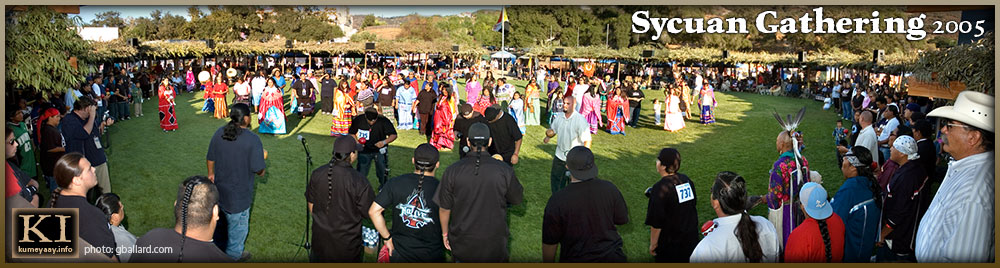
OVER 100 PROFESSIONAL NATIVE AMERICAN INDIAN EXHIBITION PHOTOS -- Over 100 professional photographs of the 16th Annual Sycuan Pow Wow featuring Yuman bird singing and Yuman bird dancing, regional gathering include the Diegueno Diegueño Kumeyaay Kumiai Tipay Iipay, Mohave, Quechan, Cocopah Cucapa, Cahuilla, Pai Pai Paipai, Ipai Tipai, Hualapai, Kiliwa, Havasupai, Maricopa, Yavapai, and Luiseño Luiseno Indians of Southern California and northern Baja California, Mexico.
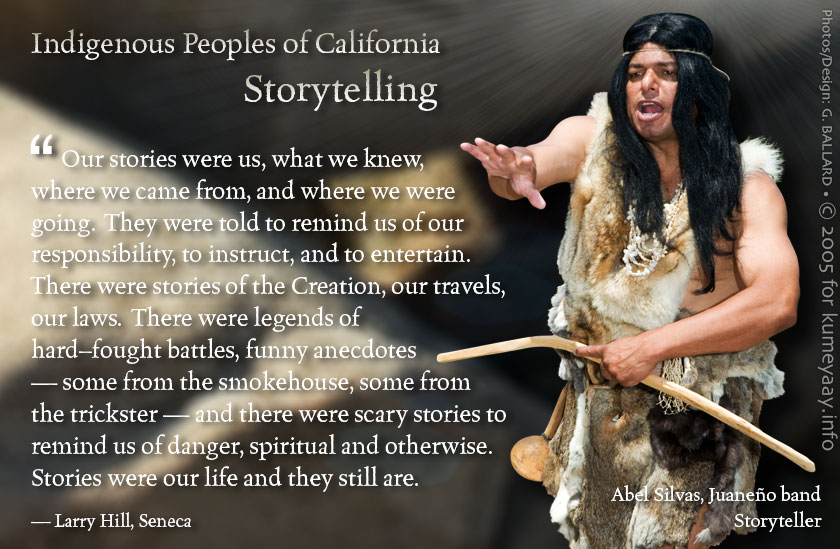
YUMAN Storytellers...
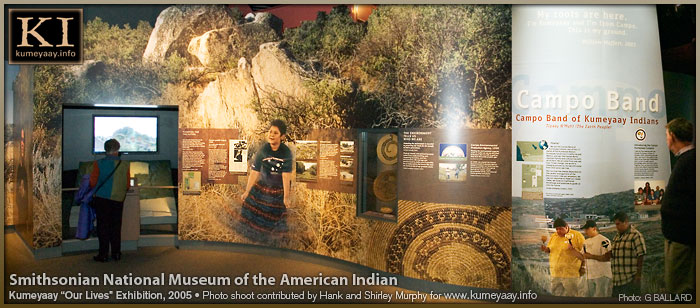
KUMEYAAY IN THE SMITHSONIAN: The Smithsonian National Museum of the American Indian "Our Lives" exhibition in Washington D.C. included a featured section on the Kumeyaay Nation -- the Campo Band of Kumeyaay Indians, Mission Indians, and their successful Golden Acorn Casino operation in Campo, California (San Diego County).
Pictures, Writing and Web Page Design Contributed by webmaster, GARY G BALLARD
|