SITE MENU includes full index of legacy directories
Hubble's Deepest View Ever of the Universe Unveils Earliest Galaxies
"Out of the ordinary...out of this world."
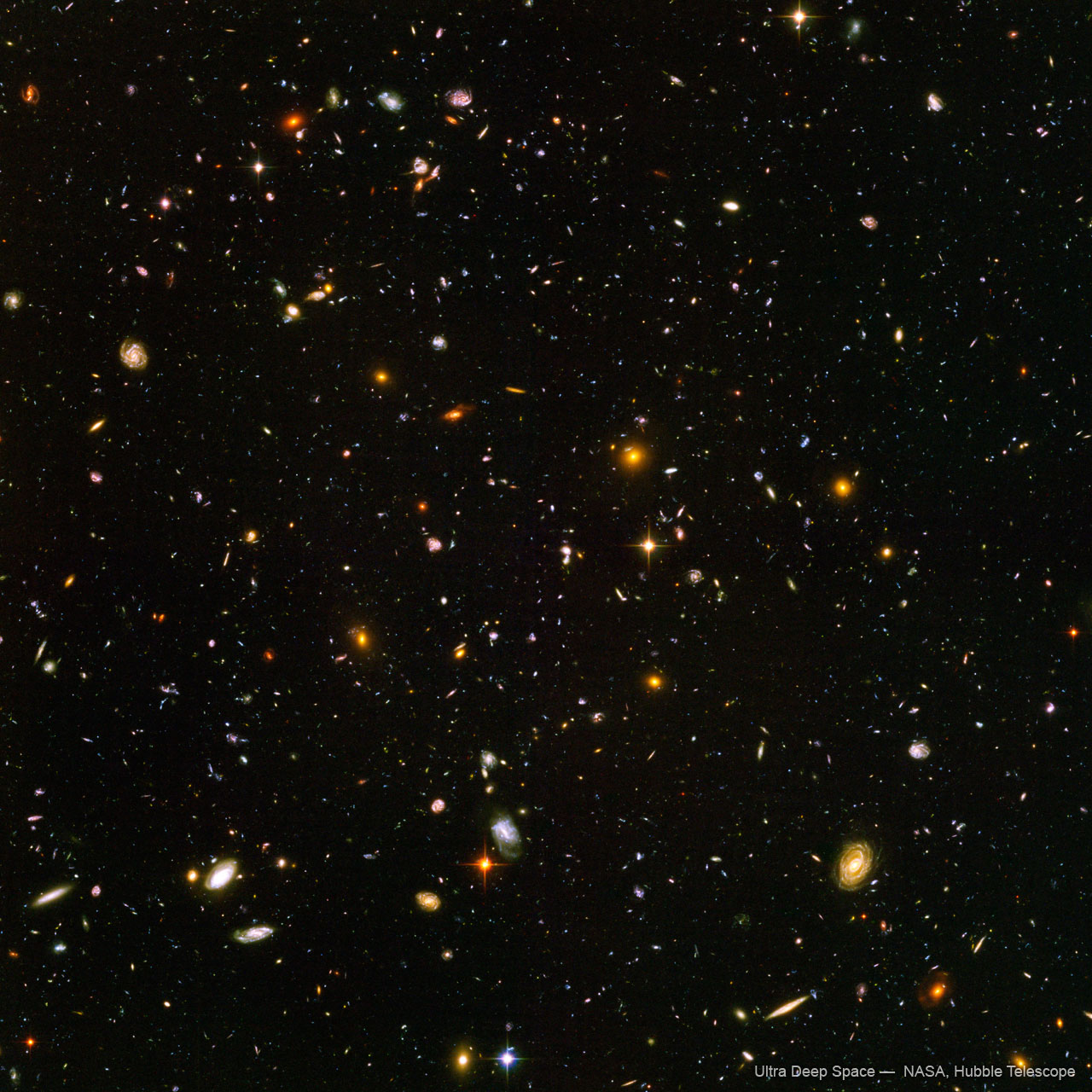
ABOUT THIS MOST FAMOUS HUBBLE SPACE TELESCOPE IMAGE:
Galaxies, galaxies everywhere -- as far as NASA's Hubble Space Telescope can see.
This view of nearly 10,000 galaxies is the deepest visible-light image of the cosmos.
Called the Hubble Ultra Deep Field, this galaxy-studded view represents a "deep" core sample of the universe, cutting across billions of light-years.
The snapshot, taken March 9, 2004, includes galaxies of various ages, sizes, shapes, and colors.
The smallest, reddest galaxies, about 100, may be among the most distant known, existing when the universe was just 800 million years old.
The nearest galaxies - the larger, brighter, well-defined spirals and ellipticals - thrived about 1 billion years ago, when the cosmos was 13 billion years old... DOWNLOAD HIGHEST RESOLUTION AVAILABLE.
MOST AMAZING SPACE IMAGE OF A GENERATION
Webmaster's Notes:
This awesome image of deep space has to be the world's most amazing picture of outer space ever taken (in my lifetime) -- it is an image our ancestors could hardly have imagined in their wildest dreams.
THE FOLLOWING YOUTUBE VIDEO will pinpoint the actual area contained in this Hubble Deep Space image -- to visualize the telescope's field of view.
I once read, if you held a grain of sand at arm's length to the sky it would fit the image area contained in the Hubble photograph.
In other words:
The image frame represents an area about the size of a grain of sand held at arm's length to the sky.
To further explore this thought: Imagine laying on the beach looking up at the sky. Then imagine a plane of sand-sized grid squares at arm's length parallel to the sky. Now imagine each square contains the 10,000 estimated galaxies in the Hubble image.
The size and scope of our universe are incomprehensible to most of us humans ... and this is only the visual information scientists can presently image with early 21st century technology ... so hold onto your hats for another 10-20 years....
Hubble Observes 13.2 Billion Year-Old Galaxy:
JANUARY 2011 (no audio) -- Take a ride into deep space to the presumed oldest galaxy, a look some 13,000,000,000 years back in time...
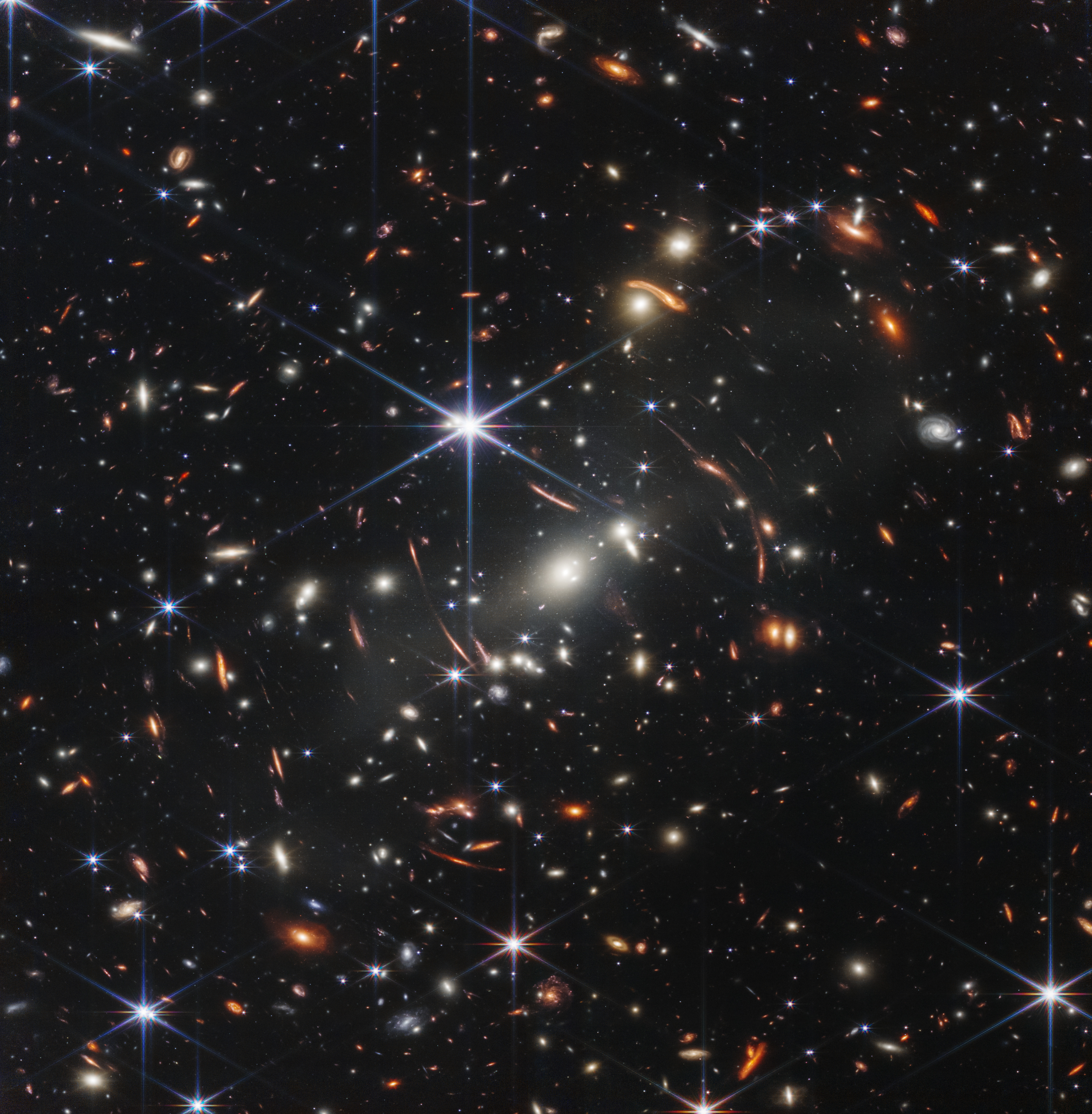
Thousands of galaxies flood this near-infrared image of galaxy cluster SMACS 0723. High-resolution imaging from NASA’s James Webb Space Telescope combined with a natural effect known as gravitational lensing made this finely detailed image possible. SOURCE.
Gravitational lensing is a phenomenon where massive objects, like galaxy clusters, warp the surrounding spacetime, acting as a lens that bends, magnifies, and distorts light from distant background sources. Predicted by Albert Einstein’s general theory of relativity, this effect allows astronomers to observe otherwise invisible, distant galaxies and detect dark matter.







 "Out of the ordinary...out of this world."