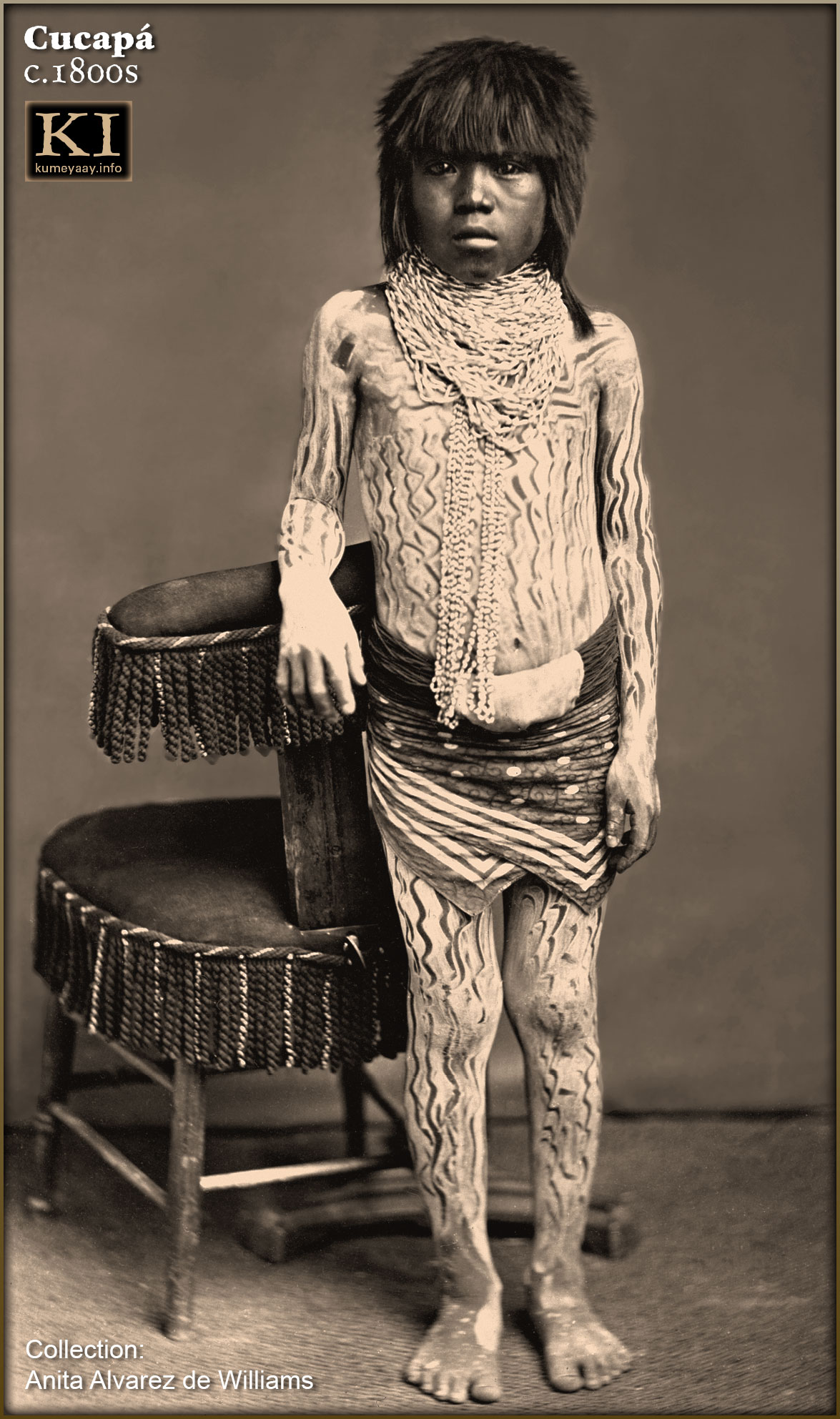
CUCAPA Aboriginal Child c. late 1800s
|
Young Cocopah child in full white body paint, period Aboriginal tribal regalia, glass-beaded or seashell necklaces, photographed in studio beside professional portrait chair. The tribes sometimes used natural white clay from the Earth mixed with gypsum to make their white body paint. Paul Campbell captioned this old 19th century studio photo: Painted Cocopa child. Note the design that results from scraping paint away with fingernails. Very old photograph. (From collection of Anita Alvarez de Williams.)
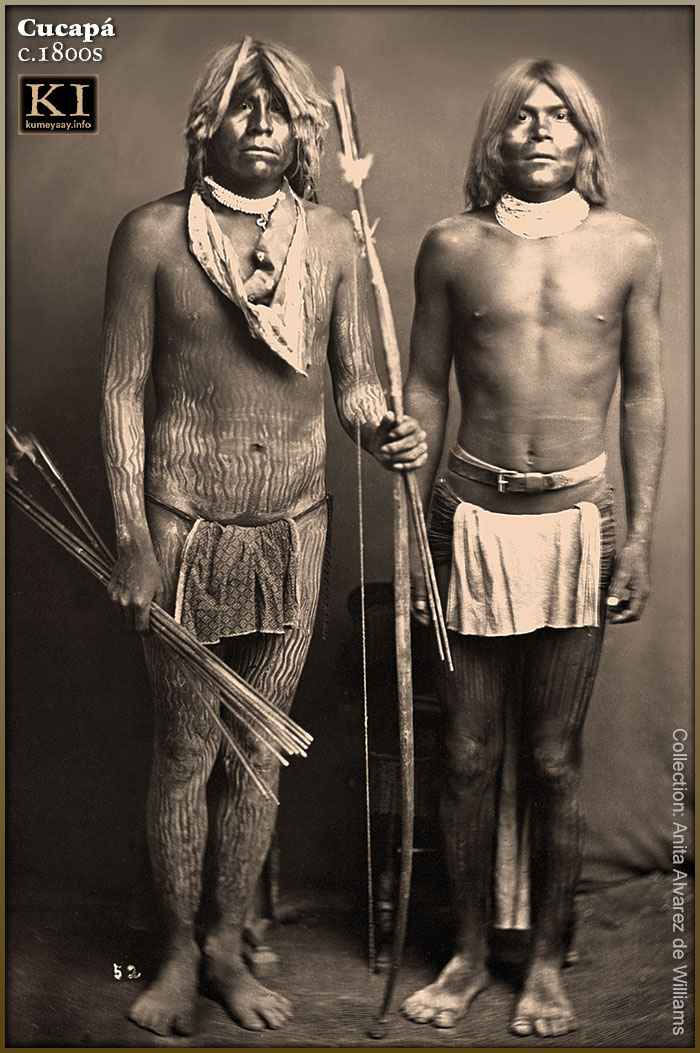
Paul Campbell captioned this old 19th century photograph: Painted Cocopa men with long bow and long carrizo cane arrows with tufted fletch and long blunt foreshaft points. The same likely scraping or removing of paint with the fingernails found on preceding photograph is seen on the body of the man to the left. Very old photograph. (From collection of Anita Alvarez de Williams.)
How the California Aboriginal tribesmen likely appeared to Portuguese explorer Juan Rodriguez Cabrillo upon "Discovery" 1542. And to Spanish explorer Gaspar de Portolà ("Invasion" 1776) -- the later historically footnoted as the founder of San Diego (and Monterey, Calif.).
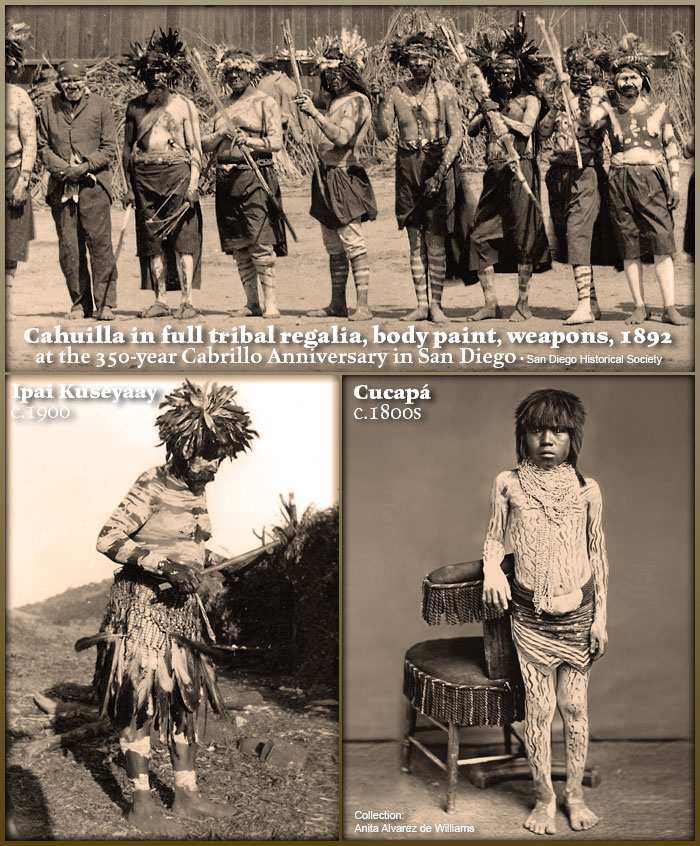
Top: San Diego region Indigenous Cahuilla men pictured 1892 at the 350-year Cabrillo anniversary of "Discovery" in San Diego (possibly at the Indian encampment at 4th and A streets). Notice their full body, chest, face and leg paint, feathered headdresses, painted bows, and thatched ewaas/kichas behind the group. The dark cloth draped around their waists also tells a story of mismatched culture between Aboriginal and immigrant standards of public decency. Lower row: A 19th century Ipai kuseyaay medicine man (shaman) on left is wearing a tribal headdress adorned with owl and hawk feathers, and fiber net skirt with attached eagle feathers, in addition to full body painting. He is a Kumeyaay spiritual, ritual, medicine, Kumeyaay cultural leader of his time (19th century).
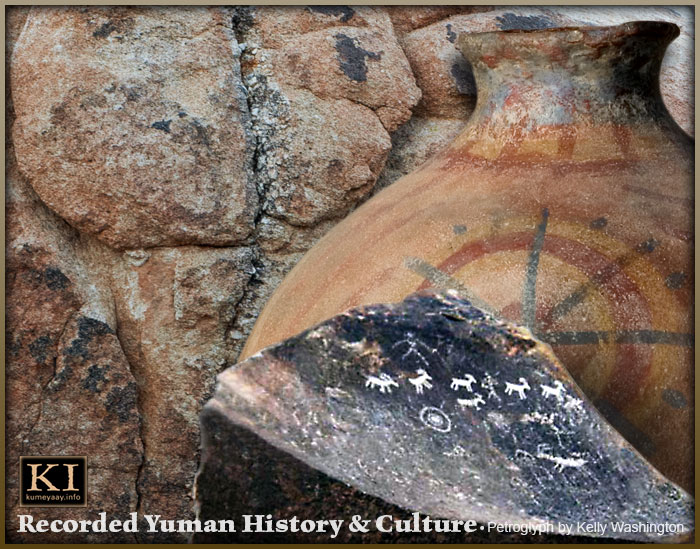
The Yoni granite sculpture background in this composited graphic was photographed at Indian Hill, Anza Borrego Desert State Park in 2004 -- notice the dark aged paint, it must have been all painted up in original celebrated form. The rare Polychrome olla was found in the late 1900s in western Imperial County. The Petroglyph rock was photographed by Kelly Washington in 2004 at Vii Kwame, a sacred mountain for many of the Yuman tribes.
Photos and text courtesy of Paul D. Campbell, author of SURVIVAL SKILLS OF NATIVE CALIFORNIA, where the KUMEYAAY.INFO excerpted material was originally published. Paul's book features living (and deceased) Native American California Indigenous people of the greater San Diego area, and details their traditional hunting, weapons and aboriginal survival methods...
A traditional men's northern contemporary dancer, Ernest Big Medicine's Cheyenne tribal regalia includes a massive feathered headdress ( dog soldiers cap ) and shoulders, white animal furs, handmade collar, necklace with colorful tribal designs patterns designs. Cheyenne Dog Soldiers pbs.org • CHEYENNE DOG SOLDIERS manataka.org Ernest Big Medicine is no newcomer to pow-wow dance competition. The seasoned dancer has been dancing "since I was seven years old...I love being in the battle zone of all the Tradish Bros," he said in an exclusive KUMEYAAY.INFO interview. Ernest Big Medicine is a member of the Bow-string Society of Sieling Oklahoma, and said he paints his face after "war, till the death, 'Back in the Day' was a fiercest warrior of all." |

 ERNEST BIG MEDICINE Southern Cheyenne
Terms of Use • Privacy Statement • Site Map • Kumeyaay Indians Research